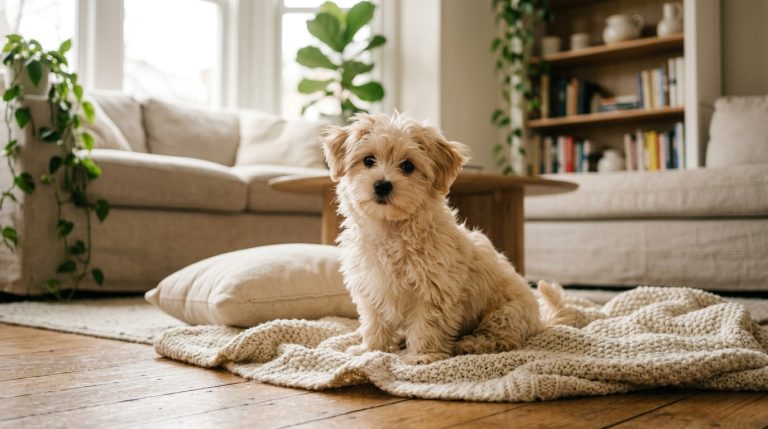
Why Morkies Are So Clingy (And What to Do About Separation Anxiety)
Last Tuesday Georgie ate my sock and acted like I’d wronged him when I took it back. He gave me that look, you know the one – the Morkie death stare that says, “I am a mighty wolf, and you have stolen my prey.” Then he proceeded to follow me to every single room in the house, just to make sure I wasn’t going to pull another sock heist. It’s exhausting, honestly. You asked why Morkies are so clingy, and what to do about it? Girl, I could write a book. Georgie is basically my shadow, but a shadow with very strong opinions about where I should be at all times.
They’re Little Velcro Dogs, It’s in Their DNA
Okay, so first things first: Morkies are a mix of Maltese and Yorkshire Terrier. Both of those breeds are known for being super attached to their people. Like, historically attached. Maltese were bred as companion dogs for European nobility, basically living in laps and being toted around. Yorkies started out as ratters in mills but quickly moved into the laps of Victorian ladies. So, you’ve got two breeds that have generations of “I need to be with my human” baked into their genetics. Georgie, bless his tiny, wolf-wannabe heart, takes this to the extreme. He thinks he’s a giant German Shepherd, but in reality, he’s a 7-pound furry limpet. If I’m in the kitchen, he’s underfoot. If I’m on the couch, he’s on my lap. If I go to the bathroom, he’s usually sitting right outside the door, huffing dramatically. It’s cute for about five minutes, then it just gets annoying.
And it’s not just a cute quirk. That intense bond can easily tip over into full-blown separation anxiety if you’re not careful. Georgie started showing signs of it pretty early on. Even if I just went to take out the trash, he’d bark and pace. When I first started leaving him alone for longer periods, say to go to the grocery store, I’d come back to scratched doors and occasional “accidents” even though he was perfectly potty-trained. His brother, Teddy, a much more chill Cavalier King Charles Spaniel, just looked at me like, “Finally, peace and quiet!” but Georgie was a wreck. He thinks Teddy is just a giant, fluffy pillow, so he doesn’t even get comfort from him.
My Failed Attempts (So You Don’t Make the Same Mistakes)
I tried all the usual stuff at first, thinking it was just puppy stuff. My vet suggested leaving a T-shirt that smelled like me. Georgie just dragged it around the house like a security blanket, but it didn’t stop the barking. Then I tried leaving the TV on, thinking the noise would be a distraction. Nope, he just barked AT the TV. I even bought him one of those Kong Wobbler treat dispensers, which usually works wonders for Teddy. Georgie would bat it around for about two minutes, eat the treats, then go back to crying at the door. He’s not easily fooled by simple distractions when he’s decided he needs to be near me.
Then I tried a calming spray, the one with pheromones, called Adaptil. It comes as a collar, a diffuser, and a spray. I got the spray, like $25 on Chewy. I spritzed it on his bed, thinking it would create a zen zone. Georgie just gave the bed a suspicious sniff and then went to sleep under my desk instead. It did absolutely nothing. Honestly, sometimes I think Morkies are immune to calming pheromones because they have an iron will.
One time, I even set up a camera. My friend suggested a Wyze Cam V3, which is only like $35 on Amazon. It’s pretty cool for checking in on them. I watched him. He’d pace, then sit by the door, then pace some more. He’d let out these little whines that just broke my heart. It was clear the issue wasn’t boredom; it was genuine distress from being alone.
What Actually Works (Mostly)
So, here’s what actually moved the needle for Georgie and his separation anxiety. It’s not a magic bullet, but it has made a huge difference:
Crate Training (The Right Way)
I know, I know, some people hate crates. But for Georgie, it became his safe space, not a prison. We started with short periods, with the door open, just putting treats inside. Then a few minutes with the door closed while I was still in the room. I used a Frisco Fold & Carry Single Door Dog Crate, 24-inch, about $40 on Chewy. It’s a basic wire crate, nothing fancy, but sturdy. I put his favorite blanket in there (not one of mine, he just dragged that out) and a chew toy he only gets in the crate. The key was never using it as punishment. Now, when I say “crate time,” he often just walks in there himself. It gives him a den-like feeling, and he feels secure. When he’s crated, he barks less because he’s not pacing the entire house looking for me.
Gradual Departures (Like, REALLY Gradual)
This was the hardest part and required the most patience. Instead of just leaving for an hour, I started with literally stepping out the door for five seconds, then coming back in and rewarding him with a treat and calm praise if he was quiet. Then ten seconds. Then I’d go to the mailbox. Then I’d go to the end of the driveway. I slowly built up the time. It took weeks, but he learned that me leaving didn’t mean I was gone forever. It helped break the association of me leaving = panic. I use super high-value treats for this, like Zuke’s Mini Naturals, Peanut Butter flavor, about $7 a bag on Amazon. Georgie will do anything for those.
Consistent Routine and Exercise
Morkies are little bundles of energy. Georgie thinks he needs to run a marathon every day, even though he’s tiny. We do two decent walks a day, even if it’s just around the block. A tired dog is a good dog, right? Before I leave, I make sure he’s had a good walk and a potty break. He’s less likely to have excess energy to fuel his panic. For walks, I use a Ruffwear Front Range Harness, size XS, about $40 on Amazon. It’s super comfortable for him, and I can clip the leash to the front if he gets a bit pully, which he does when he spots a squirrel (he thinks he can catch it, naturally).
Environmental Enrichment (When I’m Gone)
Even with the crate, I still leave him with something to do. I found that a snuffle mat, like the PAWZ Road Snuffle Mat, $18 on Amazon, is great. I hide kibble in it, and it keeps him busy for about 15-20 minutes, using his brain and nose. That mental stimulation helps tire him out. I also rotate his toys so he doesn’t get bored. Teddy, the sneaky little guy, often tries to steal Georgie’s favorite squeaky hedgehog (from BarkBox, if you’re wondering), so I make sure Georgie has his own special toys put away for when I leave. He needs to feel like his stuff is safe, even from his fluffy, toy-stealing brother.
It’s still a work in progress, honestly. He still gives me the side-eye when I pick up my keys, but the frantic barking and accidents are mostly a thing of the past. It takes a lot of patience and consistency, but it’s worth it for their well-being.
If I had to do it all again, I’d start the crate training and gradual departures even earlier.
Frequently Asked Questions
Why are Morkies often so clingy?
Morkies are prone to clinginess due to their small size, affectionate nature, and strong bond with owners. This can lead to them seeking constant closeness and attention.
What causes separation anxiety in Morkies?
Several factors contribute, including their strong attachment, lack of early socialization, changes in routine, or a history of being rehomed. They struggle when left alone.
What can I do to help my Morkie with separation anxiety?
Strategies include gradual desensitization to alone time, consistent routines, crate training, providing stimulating toys, and ensuring they get enough exercise before you leave.
Instant digital download — print at home or at your local print shop